

Story by Anthony Edwards
Distant hurricanes will send energetic waves toward the California coast Labor Day weekend, raising the risk of dangerous rip currents and sneaker waves.
The National Weather Service issued a beach hazards statement from 6 a.m. Friday to 11 p.m. Monday for Pacific beaches in the Bay Area, warning of waves up to 10 feet with long periods between them.
“These waves aren’t very intimidating if you’re on a boat in the open ocean, but the long period allows them to push much farther up the beach,” the weather service said.
- Related: Hurricane Lowell is moving toward Hawaii, raising threat of major storm hitting soon
- Read more: California is about to see a sudden foot of sea level rise from El Niño. Here’s when it hits
The holiday weekend is expected to draw crowds to local beaches and put more people at risk.
“Avoid the water if you’re not an expert swimmer,” the weather service said. “If caught in a rip current, swim parallel to shore until you stop feeling the pull. Even on the beach, be prepared for sneaker waves this weekend and never turn your back on the ocean.”
Hurricane Marie off the coast of Cabo, Mexico and Hurricane Karina in the open Pacific are expected to be the main drivers of California’s rough seas. A third storm, Hurricane Lowell, will have less impact locally, but poses an extreme risk of high surf and storm surge for parts of Hawaii.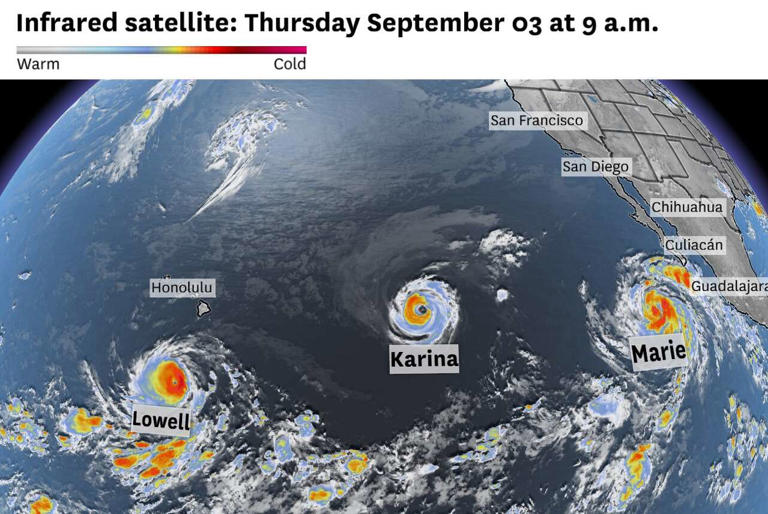
A trio of hurricanes in the central-east Pacific Ocean are churning seas from Hawaii to Mexico to California. (Baron/Lynx)
The waves could go up to 8 feet, which would be the largest of a series of tropical swells that have hit the Southern California coast this summer, weather service meteorologist Ryan Kittell said. Previous Pacific hurricanes caused significant erosion at beaches, including in Malibu. The highest tides of the month are predicted Monday, raising the chance of minor coastal flooding, Kittell said. Related video: This is how rip currents turn beaches deadly (The Weather Channel Video)
about:blank
 The Weather Channel Video
This is how rip currents turn beaches deadly
Coastal erosion will only worsen this winter as impacts of El Niño compound. Scientists predict a “coastally trapped Kelvin wave” could raise sea levels by a foot in late September and early October.